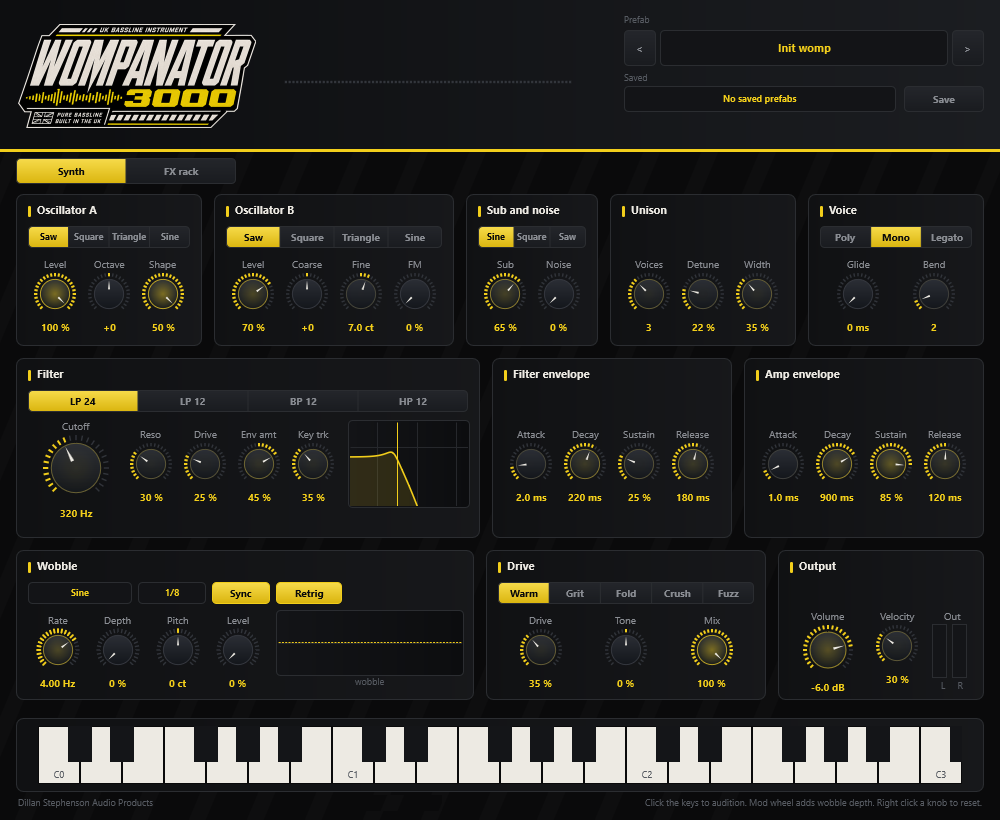
Two oscillators and a sub
Osc A and osc B share one unison bank, so voices, detune and width
widen them together. Osc B has coarse and fine tuning for a Reese,
and the FM knob folds it into osc A for growl. The sub always sits
an octave below the note you played.
A ladder filter that holds up
Four poles, solved without a unit delay in the feedback path, so it
stays stable all the way to self oscillation. Tap mixing gives a
24 dB and a 12 dB low pass, a band pass and a high pass out of the
same structure, with drive into the saturating stage.
Wobble locked to the host
Pick a division and it follows the tempo, or switch sync off for a
free running rate. Depth sweeps the cutoff three octaves either side
of where you set it, and the mod wheel adds on top, so one patch can
be played rather than automated.
Five ways to make it dirty
Warm and grit for weight, fold for the metallic Reese timbre, crush
for bits and sample rate, fuzz for hard clipping. Tone and mix sit
next to them, and a soft limiter after the stage stops anything
turning into a raw digital clip.
Four effect slots
Any slot can be a chorus, phaser, delay, reverb, compressor, EQ or
sidechain ducker, in any order. Each one gets three knobs that
relabel themselves to suit the effect you picked.
Poly, mono and legato
Eight note polyphony when you want chords, mono with retrigger when
you want punch, and legato with glide for slides. A glide of 50 to
150 ms in legato is where the bassline slide lives.